
The Story of the Smithsonian American Art Museum and Renwick Gallery
Early Years, 1829–1865
The collection began modestly in 1829 when a Washingtonian named John Varden set out to form a museum in the nation’s capital for his collection of European art. At first, the art was placed in a room he added to his own house near the U.S. Capitol.
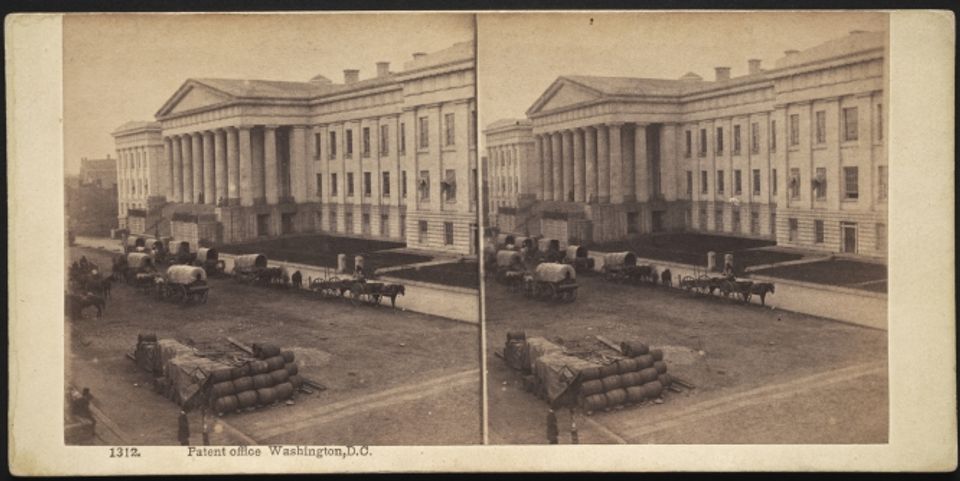
In 1841, Varden’s collection was displayed in the newly constructed Patent Office Building—coincidentally, the museum’s home today. Along with Varden’s works came Varden himself as “curator” of the newly created “National Institute” for government-owned artistic and historic items. Paintings and sculptures shared space in a large exhibit hall with the Declaration of Independence and Benjamin Franklin's printing press.
The establishment of the Smithsonian in 1846 eclipsed the prestige of the institute, which later disbanded. By 1858, a majority of the items on view at the Patent Office Building were moved a few blocks to the newly completed Smithsonian Castle. The remainder of the collection followed in 1862. But a destructive fire there in 1865 increased the Smithsonian’s reluctance to build cultural collections. For the rest of the century, most of the artwork was placed on loan to the Library of Congress and to the Corcoran Gallery of Art.
A Turning Point
A turning point in the history of the collection came in 1906. That year the probated will of Harriet Lane Johnston, an art collector and niece of President James Buchanan, forced an important decision in a federal court: the recognition that the Smithsonian’s collection formed a “National Gallery of Art.” Coined during a national art-collecting boom, the official name soon attracted major gifts. Highly prized were diverse artworks owned by John Gellatly and American impressionist paintings and Barbizon landscapes collected by William T. Evans.
A Permanent Home
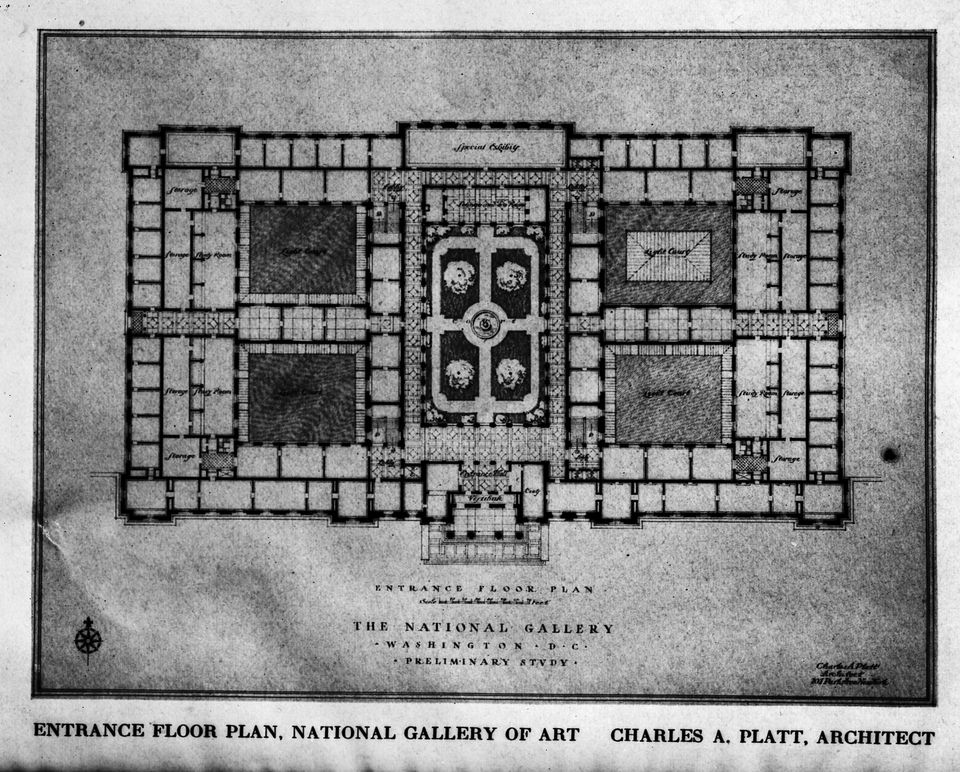
Plans to build a permanent home for the museum on the National Mall came and went, among them a prize-winning modernist structure that shocked federal officials and was never built. The competition had been organized after Andrew Mellon gave his European-focused art collection to the nation in 1937 with the stipulation that his new museum be called the “National Gallery of Art” in emulation of the National Gallery of Art in London.
To comply with Mellon’s wishes for a National Gallery of Art to house his European collection, the Smithsonian museum that had already been known as the National Gallery of Art for thirty-one years was renamed the National Collection of Fine Arts in 1937. It assumed new responsibilities in promoting the work of living artists and building a national audience.
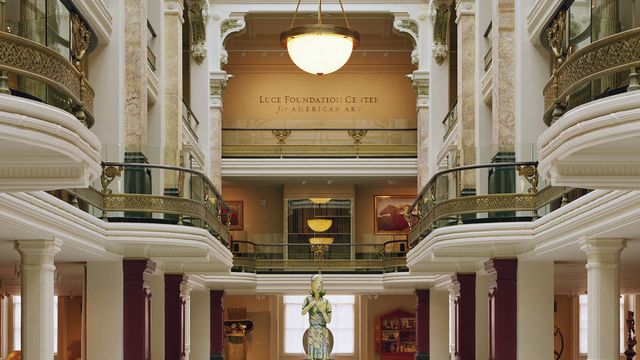
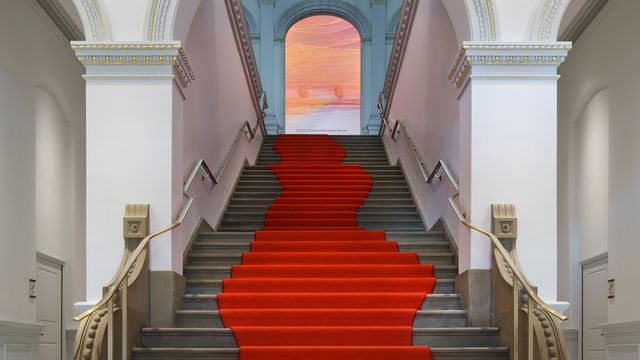
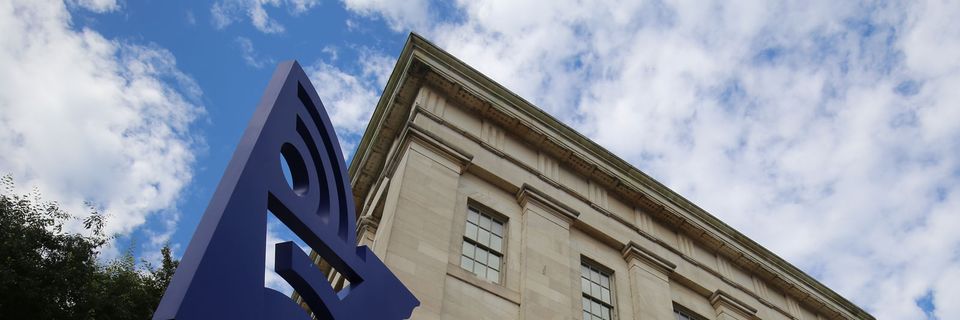
The interest in historic preservation after World War II ultimately was responsible for giving the first Smithsonian art museum a new home—and preserving an architectural treasure. In 1957, a bill was introduced in Congress to demolish the elegant Patent Office Building to make way for a parking lot. Deteriorated, but still one of the purest examples of Greek Revival architecture in the nation, the structure was saved when Congress transferred the building to the Smithsonian. In 1968, after an extensive interior renovation, the museum opened to the public. To learn more about the history of the building, visit the exhibition Temple of Invention: History of a National Landmark.
In 1972, the Renwick Gallery opened to the public as a branch museum featuring American crafts.
In 1980, the museum’s name was changed to the National Museum of American Art as part of a Smithsonian initiative to standardize the names of its many museums and to reflect the museum’s primary focus on American Art. Since then, the museum’s exclusive mission has been the acquisition, promotion, and interpretation of the work of artists in the United States. Twenty years later, the museum proposed that it be called the Smithsonian American Art Museum as an easy-to-remember name and a straightforward presentation of its mission. Congress approved this change in October 2000.