





Artwork Details
- Title
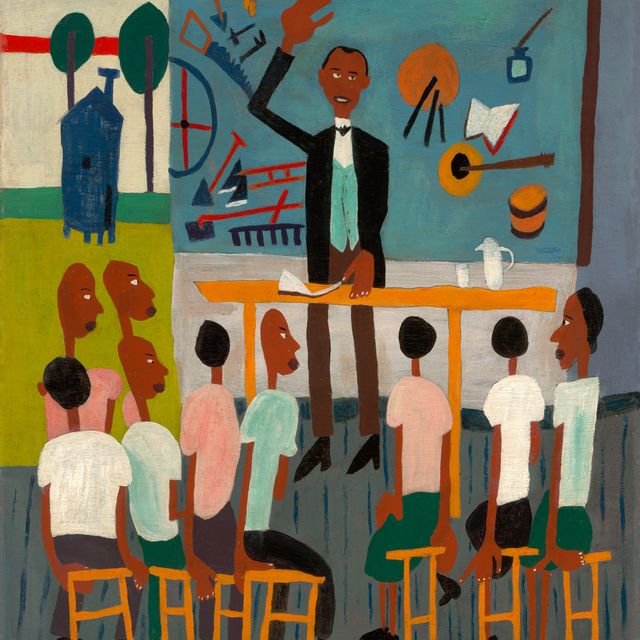
- Lucy Prince: The Griot’s Voice
- Artist
- Date
- 2012
- Location
- Not on view
- Dimensions
- 50 x 50 in.
- Credit Line
- Gift of Fleur S. Bresler
- Mediums
- Mediums Description
- cotton fabric and cotton batt
- Classifications
- Subjects
- Portrait female — Prince, Lucy — full length
- African American
- Landscape
- Object Number
- 2023.40.2
Artwork Description
Peggie L. Hartwell
born 1939, Springfield, SC
resides Summerville, SC
Lucy Prince: The Griot’s Voice
2012
cotton fabric and cotton batting
Captured and sold as part of the Atlantic slave trade, Lucy Terry Prince was enslaved for nearly two decades in the British colony of Rhode Island, and later in Massachusetts. Obijah Prince, a wealthy member of the free Black community, purchased her freedom in 1756 then married her. In 1746, while still enslaved, Prince composed the ballad poem “Bars Fight,” a direct account of a Mohawk and Abenaki ambush of English settlers in her village. This poem—one of the first pieces of African American literature—was preserved orally and eventually transcribed and published in 1855. Though “Bars Fight” is Prince’s only surviving work, she was remembered as a prolific poet and storyteller.
Smithsonian American Art Museum, Gift of Fleur S. Bresler, 2023.40.2
We Gather at the Edge: Contemporary Quilts of Black Women Artists, 2025