













Artwork Details
- Title
- Tale of 1000 Condoms/Geisha and Skeleton
- Artist
- Date
- 1989
- Location
- Not on view
- Dimensions
- 133 x 83 in. (337.9 x 210.9 cm.)
- Copyright
- © 1989, Masami Teraoka
- Credit Line
- Museum purchase through the Luisita L. and Franz H. Denghausen Endowment
- Mediums
- Mediums Description
- watercolor and sumi-e ink on canvas
- Classifications
- Subjects
- Figure female — full length
- Japanese
- Occupation — other — prostitute
- Figure — fragment — skeleton
- Dress — Japanese dress
- State of being — illness — AIDS
- Object Number
- 1996.105
Artwork Description
In my early paintings I used watercolor on paper to mimic woodblock prints. But the magnitude of the AIDS epidemic seemed to demand large-scale paintings. – Masami Teraoka
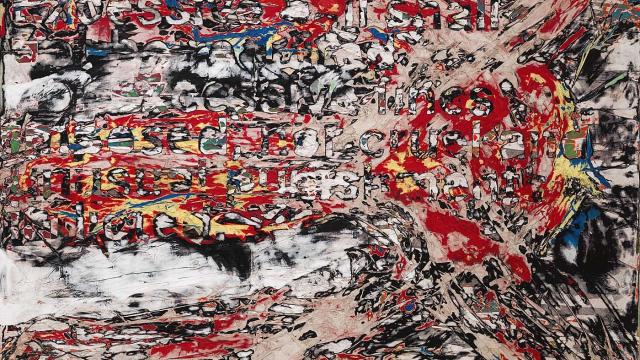
Created before antiretroviral treatments for HIV became available, Tale of 1000 Condoms/Geisha and Skeleton represents a geisha's "uncontrollable fear" of contracting the virus. She anxiously rips open a condom as she awaits her evening clients. A former customer who has died of AIDS-related illness returns in the form of a skeleton. Their conversation is inscribed in Japanese on the canvas:
Geisha: Oh my god, it's you that came back?
Skeleton: Yes, it's me again, I took the subway to get here. I felt bad because everybody was afraid of me.
The work is part of a series Masami Teraoka began in 1986 responding to the plague of AIDS. To match the power and impact of the crisis at that time, he worked on a larger scale than ever before. Mimicking the style of Japanese ukiyo-e, or "floating world," woodblock prints, Teraoka's paintings depict scenes of terror, struggle, and loss in a world menaced by a deadly disease.