
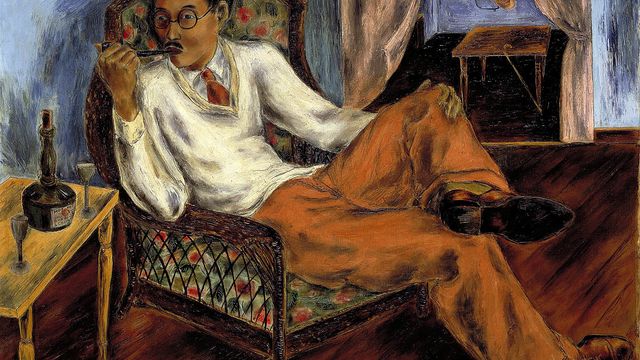




Felrath Hines developed as an artist in New York, but enjoyed his most productive years as a painter in Washington. Trained at the Art Institute of Chicago, Hines moved to New York in 1946. During the 1960s, he was part of the Spiral Group, an artist collective that met weekly to discuss the role of African American artists in relation to politics and the civil rights movement. Hines was among the Spiral members who maintained that black painters should not be obliged to use their art to convey socially engaged subject matter.
In 1972, Hines became a conservator at the Smithsonian's National Portrait Gallery and later worked at the Hirshhorn Museum and Sculpture Garden. Like Alma Thomas, he was only able to dedicate himself to painting full-time after he retired. By then committed to geometric abstraction, he found a home for his art in the DC region, presenting five solo exhibitions at area galleries in the last decade of his life. Within an art scene famous for its color abstraction, Hines's paintings are distinguished by their unusual, subtle hues, flawlessly smooth surfaces, and dynamic yet harmonious composition.
Hines painting method involved the painstaking application of countless layers of color, a process that yielded depth and luminosity as well as pristine surfaces. In Radiant, he works within a restricted color scheme, playing dark and light values of blue and lavender-gray against gentle beams of peach and yellow. At first glance, the edges of the composition appear precise, but Hines applied them freehand, without the use of masking tape, so they wouldn't feel mechanical, or in his words, "stiff." While other Washington painters such as Gene Davis and Alma Thomas emphasized pattern and rhythm in their work, Hines valued balance and harmony above all, as a means of conveying, "visual as well as spiritual pleasure."